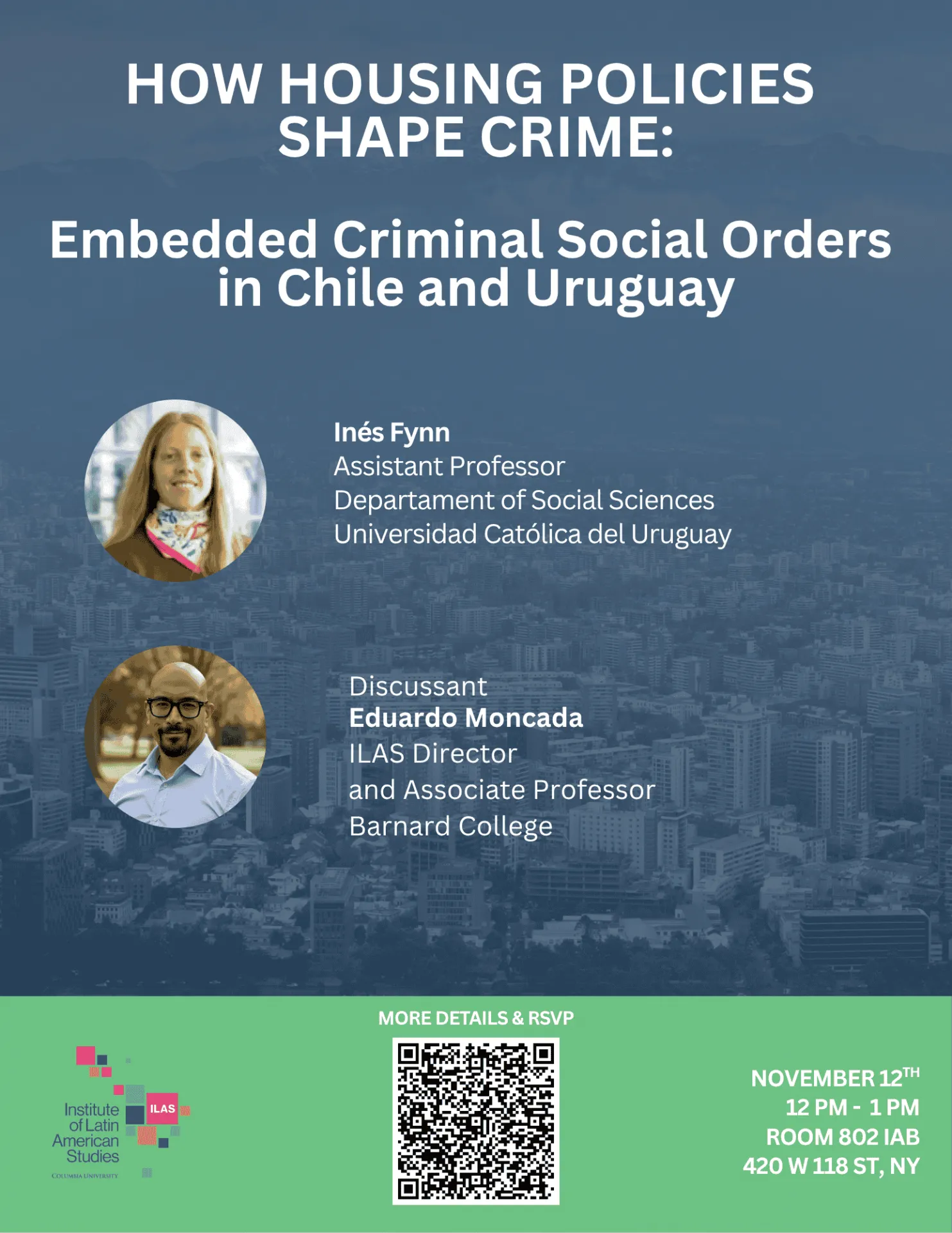
How Housing Policies Shape Crime: Embedded Criminal Social Orders in Chile and Uruguay
Fynn investigates how historical housing policies shape contemporary forms of criminal governance in Latin America. Focusing on Chile and Uruguay—two countries often considered peripheral to the region’s criminal violence epicenters—it argues that variation in community structures forged by past housing policies explains why some neighborhoods experience negotiated coexistence with gangs, while others are dominated through coercion. The study develops the concept of Embedded Criminal Social Orders (ECSOs) to capture these relational arrangements between gangs and communities. Unlike top-down models of criminal governance, the ECSO framework emphasizes the local embeddedness of criminal groups in community networks, reciprocity norms, and organizational traditions. Drawing on comparative fieldwork in four neighborhoods of Santiago and Montevideo, the analysis shows that communities formed through collective land-takeovers and self-construction (“emblematic neighborhoods”) tend to sustain cohesive social networks that enable residents to discipline gangs and negotiate coexistence. In contrast, neighborhoods created through state-led relocation and mass-housing programs (“alluvial neighborhoods”) are marked by fragmentation and weak associational life, providing fertile ground for coercive domination. The findings show that criminal orders are path-dependent: state interventions in urban space have enduring effects on the forms of local order that emerge under criminal influence. By integrating insights from collective efficacy theory and the comparative politics of crime, the paper highlights the central role of community agency and institutional legacies in shaping how crime and governance intertwine in urban peripheries.
Bio:
Inés Fynn is Assistant Professor at Departamento de Ciencias Sociales at Universidad Católica del Uruguay. She received her Ph.D. in Political Science at Pontificia Universidad Católica de Chile. Her research focuses on urban informality, organized crime, and citizen-state relations with a regional focus in Latin America. Her work has been published in Perspectives on Politics, Latin American Politics and Society, Revista de Ciencia Política, and American Behavioral Scientist.
Discussion by ILAS Director Eduardo Moncada
Bring your lunch and join us for a lunchtime conversation regarding pressing issues in Latin America.