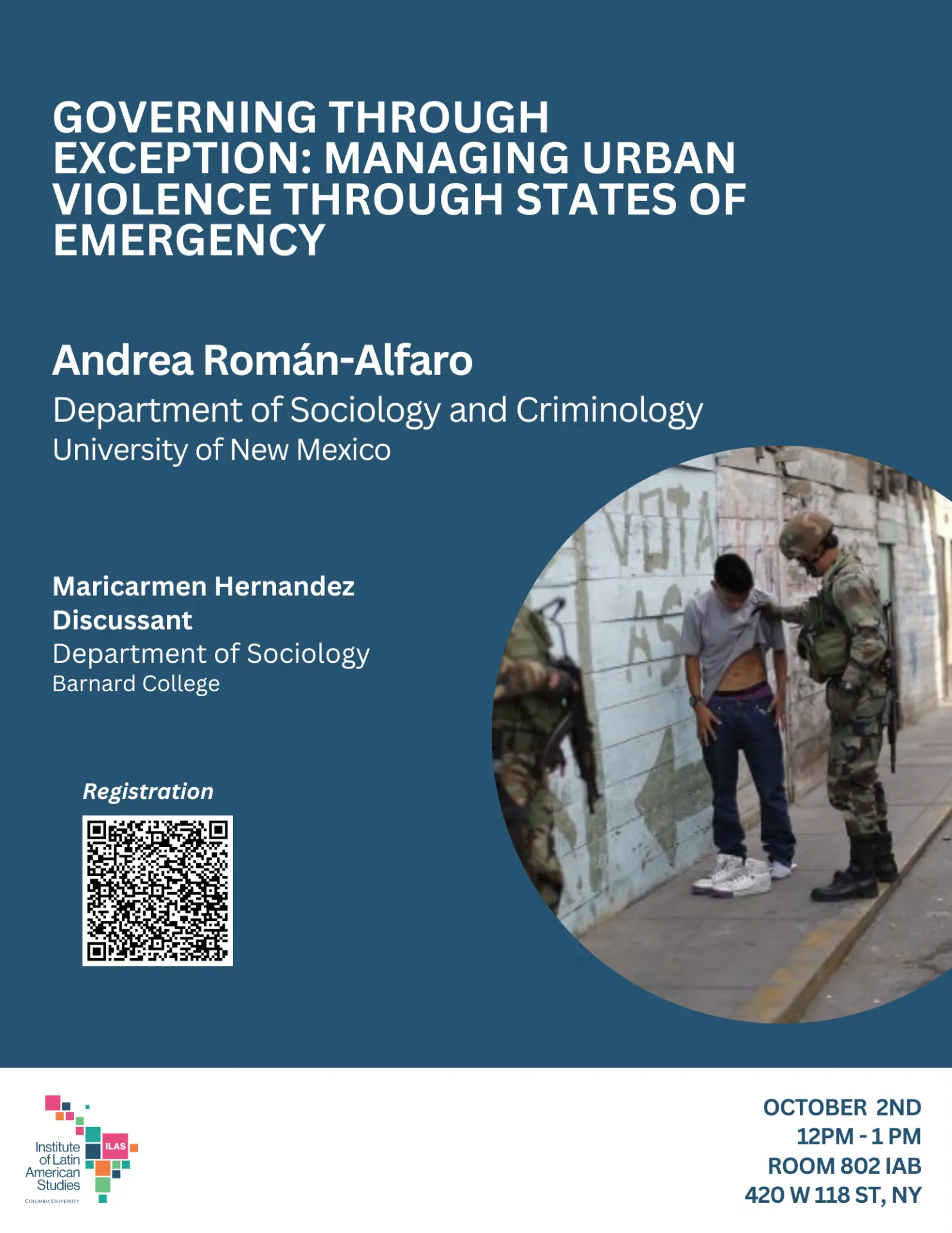
GOVERNING THROUGH EXCEPTION: MANAGING URBAN VIOLENCE THROUGH STATES OF EMERGENCY
Andrea Roman-Alfaro, Department of Sociology and Criminology, University of New Mexico
Discussant: Maricarmen Hernandez, Department of Sociology, Barnard College
Abstract: Existing scholarship critiques states of emergency (SoEs) as authoritarian tools that erode democratic norms, often assuming a cohesive state capable of uniformly enforcing control. This paper challenges that view by examining emergency powers in a context of limited institutional capacity. Based on 16 months of ethnographic fieldwork in Callao, Peru—including interviews and focus groups with residents, officials, and community leaders—it analyzes the Peruvian government’s recurrent use of SoEs to manage urban violence. The study shows how state actors employ SoEs not merely to assert political control but to pragmatically overcome bureaucratic, legal, and institutional constraints. SoEs enable inter-institutional coordination and temporarily restore symbolic authority amid public crises. The paper introduces the governing through exception framework to explain how emergency powers become routine governance tools. This reconceptualization offers broader insights into the pragmatic use of exceptional measures by states facing institutional and political constraints across Latin America and other regions.
Andrea Roman Alfaro is an Assistant Professor of Sociology and Criminology at the University of New Mexico in Albuquerque. She earned her Ph.D. in Sociology from the University of Toronto. Andrea’s research centers on qualitative methods, with a focus on how social structures shape people’s interpretations, experiences, and responses to violence. Her work pays particular attention to the experiences of women living in marginalized urban neighborhoods, examining the social and political processes that sustain and reproduce urban and gendered violence. Currently, Andrea is leading a community-based research project in Peru that uses participatory photography and photo elicitation to explore how children and youth make sense of everyday life amid overlapping forms of violence. She publishes in both Spanish and English, with articles appearing in The British Journal of Criminology, Gender & Society, Social Justice: A Journal of Crime, Conflict & World Order, and Curriculum Inquiry. Andrea has worked as a researcher and educator in Peru and Canada, and her scholarship has been supported by the University of Toronto, the Government of Ontario, the Government of Canada, and the Government of Peru.