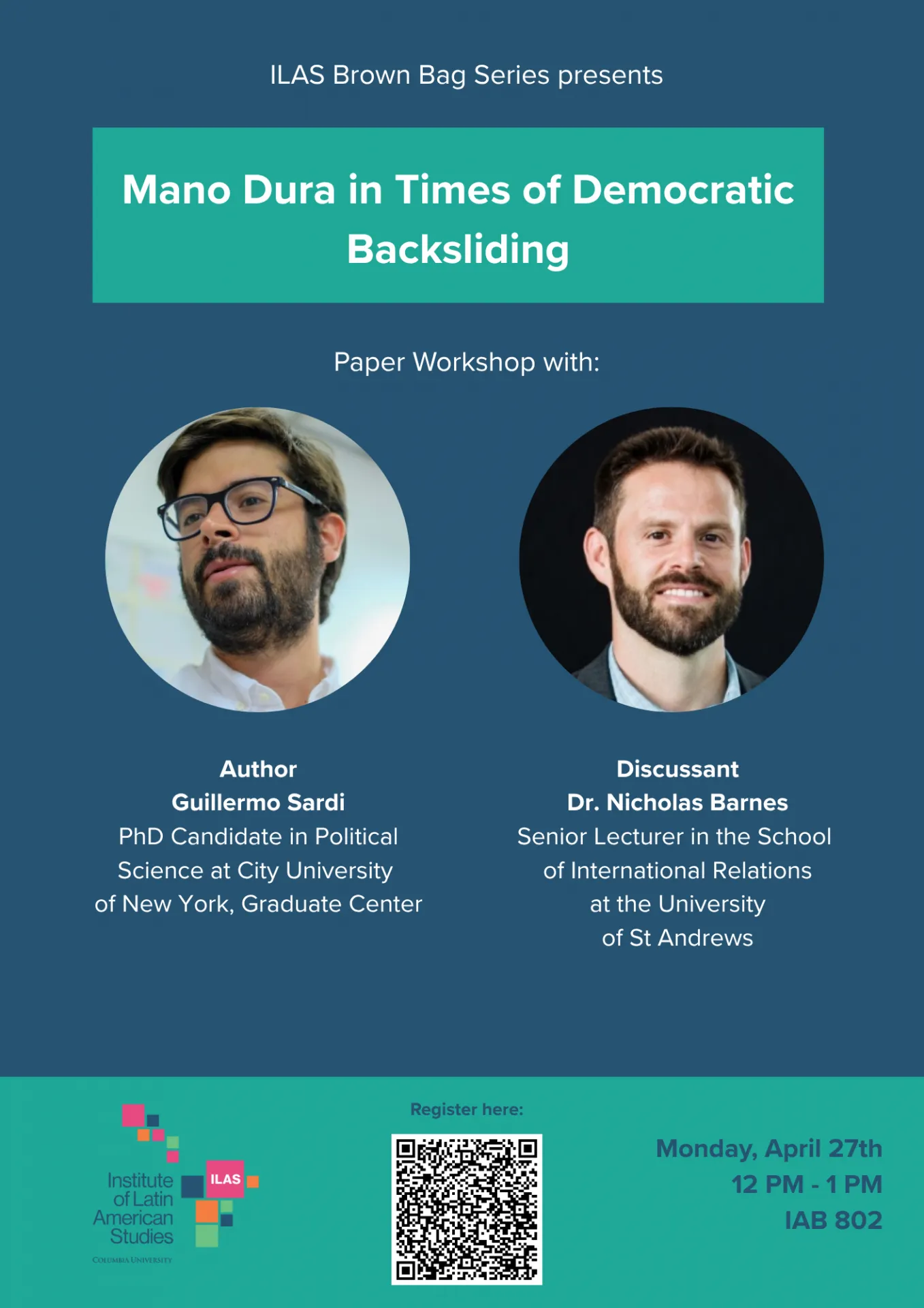
Paper Workshop: Mano Dura in Times of Democratic Backsliding
Abstract: Why do Mano Dura campaigns sometimes contain criminal organizations despite extensive scholarship showing that militarized policing and mass incarceration are counterproductive? This paper addresses this puzzle by examining variation in coercive anti-crime strategies in El Salvador and Venezuela. Existing research demonstrates that punitive campaigns strengthen criminal organizations, provoking violent retaliation or expanding criminal governance. Yet recent experiences in both countries suggest that under certain conditions, Mano Dura strategies can contain criminal groups and reduce their territorial control. I propose a theoretical mechanism explaining when these strategies produce containment. Mano Dura campaigns become effective when three conditions occur simultaneously: centralized executive power that weakens horizontal and vertical accountability, the organizational dislocation of criminal groups through centralized negotiations with their leadership, and rapid, high-intensity coercive campaigns that overwhelm fragmented organizations. The argument is evaluated through a qualitative historical comparison of six security campaigns in El Salvador and Venezuela. Drawing on sixty-seven interviews, documentary sources, and secondary literature, the analysis shows that containment occurs when these three conditions converge.
Guillermo Sardi is a PhD Candidate in Political Science at City University of New York, Grad Center, and currently a visiting scholar of Columbia University's Institute of Latin American Studies. His areas of scholarship include Comparative Politics, Democratic Backsliding, Authoritarian Regimes, Criminal Governance, and Latin American Politics.
Discussant Dr. Nicholas Barnes will serve as discussant and will offer the main set of comments on the paper. Barnes is a Senior Lecturer in the School of International Relations at the University of St Andrews, whose research focuses on political and criminal violence, illicit markets, public security, and non-state governance in Latin America.
Note: The paper will be shared with registered participants one week in advance. Please make sure to register so that you can receive a copy of the working paper.