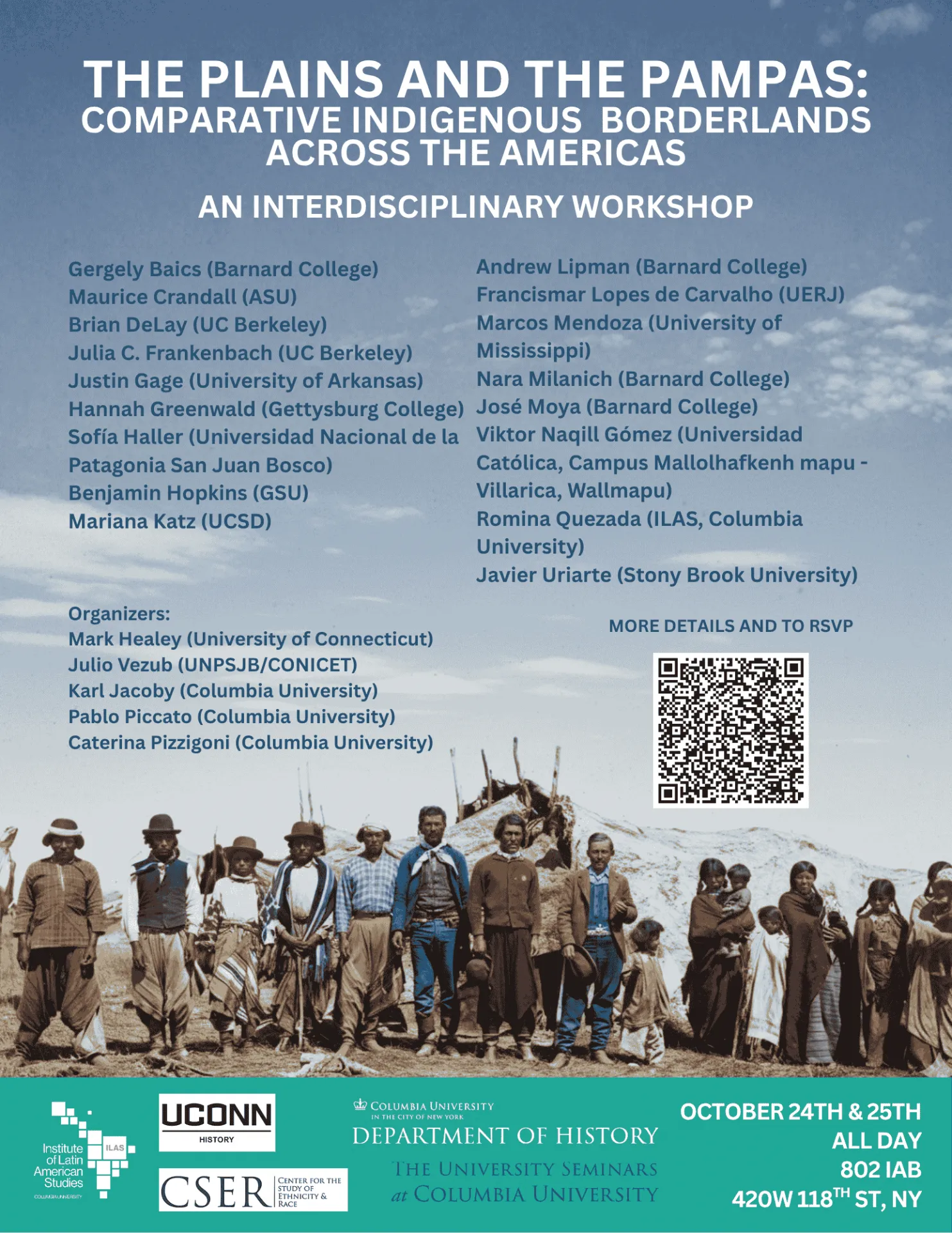
Join us for a 2 day conference in collaboration with the University of Connecticut's (UConn) Department of History, Columbia Department of History, Columbia Center for the Study of Ethnicity & Race, and the University Seminars of Columbia University.
This conference will revisit the discussion on the comparative historiography of indigenous borderlands. Beginning from with mid-1990s scholarship, it will incorporate the great but until now largely separate advances in South and North America, while taking stock of important shifts towards the more prominent role of indigenous scholars, settler colonialism theory, environmental history, and scholarly
engagement with contemporary struggles.
The conference will bring together scholars working in History, Anthropology, Native American and Indigenous Studies, and related fields. The proposal is to go beyond national historiographical frameworks, opening the way to transnational approaches. The workshop
aims to deepen the continental comparisons of indigenous borderlands, tracing similarities and differences to develop connected approaches.
October 24: 8:30am to 4pm
October 25: 9am to 5pm
Organizers:
Mark Healey (University of Connecticut)
Julio Vezub (UNPSJB/CONICET)
Karl Jacoby (Columbia University)
Pablo Piccato (Columbia University)
Caterina Pizzigoni (Columbia University)
Presenters:
Gergely Baics (Barnard College)
Maurice Crandall (ASU)
Brian DeLay (UC Berkeley)
Julia C. Frankenbach (University of California, Berkeley)
Justin Gage (University of Arkansas)
Hannah Greenwald (Gettysburg College)
Sofía Haller (Universidad Nacional de la Patagonia San Juan Bosco)
Benjamin Hopkins (GSU)
Mariana Katz (UCSD)
Andrew Lipman (Barnard College)
Francismar Lopes de Carvalho (UERJ)
Marcos Mendoza (University of Mississippi)
Nara Milanich (Barnard College)
José Moya (Barnard College)
Viktor Naqill Gómez (Universidad Católica, Campus Mallolhafkenh mapu -Villarica, Wallmapu)
Romina Quezada (ILAS, Columbia University)
Javier Uriarte (Stony Brook University)